Every signal was green. My blue chip nosedived anyway. The loss that gives investors nightmares — and what it taught me.
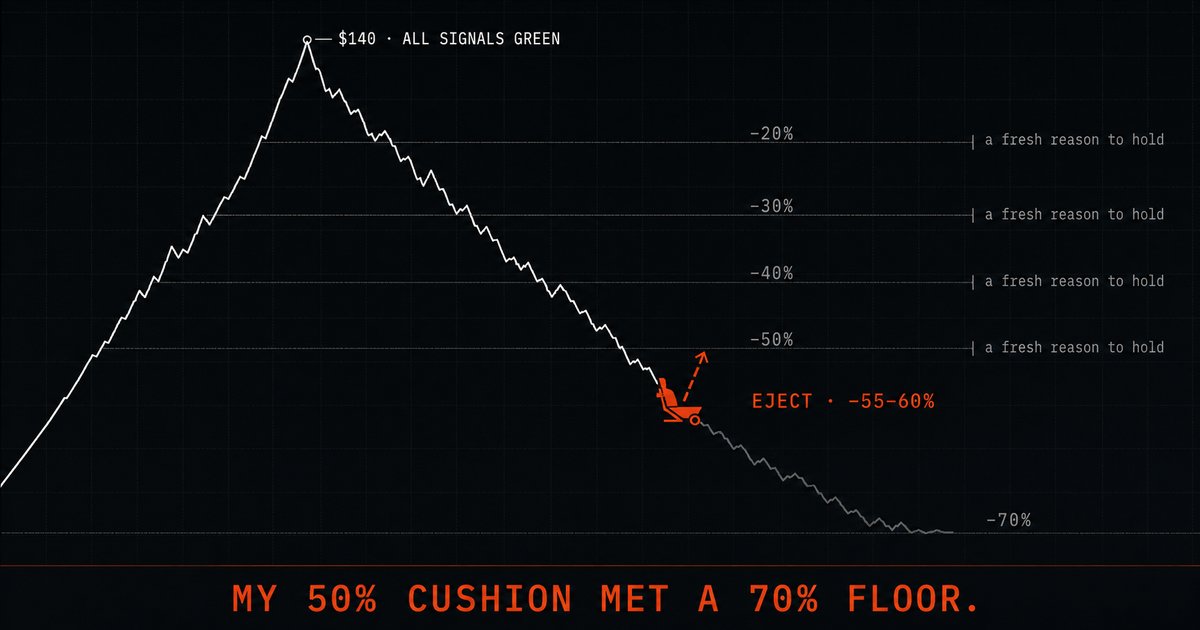
The loss every investor fears most isn't the gamble you knew was a gamble. It's the big bet where you're sure — the thesis is right, the trend is confirmed, the company is a blue chip with decades of reliability — and every signal you were taught to trust stays green while the stock nosedives for two years, taking all of its shareholders down with it, pulling up just before ground level. I lived that one. Here's what it cost and what came out of it.
In 2024 I bought Novo Nordisk (NVO) near its all-time high, around $140. My thesis: GLP-1 drugs would become one of the biggest healthcare markets in history, ending in a duopoly — Lilly leading the US, Novo leading Europe, each company strongest on its home turf, reinforced by the regulatory environment in each geography. That map turned out to be roughly right. Demand was real, the science was real, Novo's execution was real. And I wasn't reckless about price: I'd built in what I considered a 50% margin of safety against the growth in front of it.
I sized the position big — shares, plus a lot more exposure through options — and over the next 18 months the stock fell from ~$140 to the mid-$30s. I didn't sell at down 20%, or 30%, or 40%, or even 50% — there was always a reason to believe in the turnaround. I finally exited around a 55–60% loss, when the size of the loss simply no longer made sense to carry. The stock kept falling after I sold. The options went to zero. My 50% cushion met a 70% floor.
What actually happened wasn't one miss — it was a stack of them:
The profit pool sat on the other side of my map. The duopoly happened — but the US turned out to be where the pricing power and profits were concentrated, and that was the geography my own thesis had assigned to the competitor. Lilly's drug posted superior head-to-head data on top of its home-field advantage, and share shifted faster than Novo's multiple could survive. Winning Europe wasn't worth what the price assumed.
A gray market ate the pricing umbrella. Because the FDA declared an official shortage, compounding pharmacies could legally mass-produce GLP-1 copies — and hundreds of telehealth startups sold them at a fraction of branded price. Many became wealthy overnight, some with no real oversight at all. And it hit hardest in the US — the market that mattered most.
And it happened fast, while the referees moved slow. The gray market collapsed branded pricing at internet speed; the FDA and the courts moved at government speed. By the time the shortage was declared over and the lawsuits and enforcement landed, the category's economics had already reset underneath the incumbents. The rules that protected the moat changed under my feet, in a direction I never modeled — and the correction came far too late to matter.
The part nobody prepares you for is the ride itself. A stomach-wrenching, nosebleed dive in valuation where you hit zero gravity and want to throw up every day — for two years straight — as hard-earned lifetime savings go into the toilet and you feel so, so dumb about a decision that looked so smart on the way in. Shareholders are passengers. You trust the pilots — company management — to pull the aircraft out of the nosedive, because it's a well-built plane that has flown reliably for decades. Meanwhile valuation drops below any semblance of historical levels, every model says "cheap," and you don't know where the ejection seat is — or whether pulling it now locks in the worst possible outcome. And the truth is, you're not just uncertain — you're fighting yourself not to pull it. Because pulling it means locking in the losses, admitting you were wrong, and taking your comeuppance in full. At every floor — down 20, 30, 40, 50 — there was a fresh reason to hold. I pulled the seat at 55–60% down. A cushion I'd have called paranoid was blown straight through.
Three rules came out of the wreckage — none original, most tracing to Graham's The Intelligent Investor, but writing them down changed everything:
1. The thesis must carry the arithmetic, not just the map. My map — a two-company duopoly split by geography — was basically correct. What I never wrote down was the math underneath it: where the profit pool actually sat, and what my company's share of it had to be worth to justify $140. A thesis can be directionally right and still not support the price you paid.
2. A margin of safety must be sized for structural shocks, not ordinary disappointment. Even a 50% haircut — a cushion most investors would call conservative — wasn't enough when the profit pool tilted to the competitor AND a legal gray market undercut the entire category at once, with slow referees letting it run. For a richly-priced leader, the real protection isn't the discount — it's position sizing that assumes something you can't name — and don't control — will go wrong.
3. Leverage removes your right to be temporarily wrong. Shareholders who held still own a quality business earning real money at ~11x earnings today. My options had expiration dates. Right thesis + wrong timeline + leverage = permanent loss.
My exit conditions now get written the day I buy, and they name company-specific falsifiers — competitor share data, head-to-head trials, regulatory-status changes, where the profit pool is moving — not just "does the trend hold." If those had existed, I'd have exited at the first broken falsifier instead of negotiating with myself at every floor on the way down.
Most of us are bad at this. I certainly was, and the tuition was real money. And here's the part I sit with most: almost none of what broke this trade was under my control — not the FDA's actions, not the gray-market actors and their supply chains, not the competitive field, not the cockpit of the company itself. Unknown forces can arise unexpectedly even around well-researched, well-behaved, trusted companies — and when they all go wrong together, the trust breaks. Yet the investor is still responsible for everything. At the end of the day, you make the decision, and you carry all of the risk — known and unknown. That's the weight of the seat.
Curious how others here size a margin of safety not just for the risk you can't name, but for the forces you'll never control — because the risk I could name and the forces I could control aren't the ones that got me.